EREBOR
English

ΟΔΥΣΣΕΙΑ

The Odyssey

Ten years of the road home

Author
Homer
Period
8th century BC
Stations
10

The Odyssey is not a poem about a war. By the opening of the first book the war is over and has been lost by everyone, the winners included.

It is a poem about coming back. About a man Homer calls πολύτροπος — “of many turns”: the one who can twist out of anything, outthink anyone, find the way around. For twenty years that gift saves his life, and for twenty years it keeps him from reaching his house, because every victory of the mind comes with a bill.

The ten stations below are the whole road: from the smoke over Troy to a bowstring drawn in his own hall. Go down.

I

Ἴλιος

The Ash of Ilion

Troy, the coast of Asia Minor

The city was not taken by force. It was taken by an idea, and the idea was his.

For ten years the Achaeans stood under the walls of Ilion, and for ten years the walls stood. Achilles died. Hector was killed and mourned. Ajax lost his mind and threw himself on his own sword. The gates never opened.

Then Odysseus proposed the one thing nobody had proposed: stop fighting. An enormous wooden horse abandoned on an empty beach looked like a parting gift to the gods from a broken army on its way home. The Trojans pulled down part of their own wall to drag it inside. That night the horse opened.

By morning nothing was left of Ilion but smoke. Twelve ships rode low with plunder as they pulled away from the shore, and he was certain he would be home within the month. He was wrong by ten years. The mind that took Troy did not yet know that the gods send a separate bill for victories like that — and that paying it would take longer than the war.

II

Λωτοφάγοι

Sweet Forgetting

The land of the Lotus-Eaters

The first enemy on the road home was not a monster. It was peace and quiet.

A storm off Cape Malea tore the squadron off course and carried it nowhere in particular for nine days. On the tenth a shore appeared: a quiet country where people live on the flower of the lotus. The scouts were met without any malice at all. They were simply offered food.

Whoever tasted the lotus neither died nor suffered. He stopped wanting to go home. The memory of Ithaca was not erased — it merely lost its weight, the way a stone does under water. Why row twenty years against the wind when you can stay here on the warm sand and want nothing further?

Odysseus dragged his men back by force and lashed them under the rowing benches while they wept and begged to be let go. Homer put this scene at the very start of the road for a reason: almost everything that follows — Circe, Calypso, seven years on an island where life is good — will be the same temptation in new scenery. The temptation to stop going back.

III

Πολύφημος

Nobody

The cave of the Cyclops

He called himself Nobody and lived. He said his real name and lost everything.

The cave stood empty, full of cheese and milk, and the men begged him to take the haul and run. Odysseus wanted to wait for the owner — out of curiosity, and out of a calculation about the gift owed to a guest. The owner turned out to be Polyphemus: one-eyed, the height of a cliff, and he sealed the entrance with a stone twenty men could not have shifted. Then he began eating them, two at a time.

A sword solved nothing here: kill the Cyclops and everyone dies sealed in the cave. Only wit was left. Odysseus poured him unmixed wine and gave his name as Οὖτις — “Nobody”. That night the glowing stake went into the single eye. Neighbouring Cyclopes came running at the screaming: who has hurt you? — Nobody! — and they went away again, deciding he was raving. In the morning the blinded giant ran his hands over the backs of his sheep as he let the flock out, and the men walked free, clamped to the wool of their bellies.

And then, safe, from the deck, Odysseus turned and shouted his real name across the water. He needed the victory to have a name attached. Polyphemus heard it — and called on his father. His father was Poseidon. From that second the sea, the one road home, became the enemy. The mind that saved him is the mind that doomed him.

IV

Αἴολος

Nine Days Without Sleep

The floating island of Aeolus

He was close enough to make out the cooking fires on Ithaca. And then he fell asleep.

Aeolus, keeper of the winds, took them in as friends and gave a parting gift nobody else had ever received: he shut every contrary gale into a leather sack and left only the west wind loose. The way home turned into a straight line.

For nine days and nights Odysseus never let go of the steering oar and never closed his eyes — he trusted the sack to no one. On the tenth day Ithaca rose on the horizon, close enough to make out smoke and the fires on the beach. And then he slept.

The crew had been staring at that sack for nine days. They were certain their captain was dividing the spoils unfairly and hiding the gold of Troy inside it. They untied the knot in sight of home. The escaping winds flattened the sails and threw the ships back in one motion — all the way to the island of Aeolus. This time the keeper of the winds drove them off his threshold: a man so plainly hated by the gods is not a man you help. The closest Odysseus ever came to home, he came in his sleep.

V

Κίρκη

The Cup and the Year

The island of Aeaea

To come back to the living, she said, you will first have to go down to the dead.

On Aeaea the scouts were met by a woman at a loom, singing in a way that made leaving difficult. Circe fed them, gave them wine with something stirred into it, and touched them with her wand. Inside they stayed men: they understood everything, remembered their own names and wept, but their bodies were swine and they could not shape a single word.

Odysseus was saved by Hermes, who handed him the herb μῶλυ — a black root with a white flower that no mortal digs up unaided. The drug failed, and the sorceress, meeting for the first time someone she could not transform, conceded and gave the crew their shape back.

Then came the least dignified part: they stayed. Not as prisoners — as guests. A full year, warm, well fed, until his own men came to Odysseus and asked whether he still remembered where they had been sailing. On leaving, Circe gave him not a chart but a condition he could not refuse: no living man has a road to Ithaca until he has gone down into the kingdom of the dead and asked the blind prophet about it.

VI

Νέκυια

The Descent

The edge of Ocean, the grove of Persephone

He came to ask for directions and was told how all of it ends.

At the edge of Ocean, where the sun never rises, he dug a pit and filled it with sacrificial blood. The dead came up at the smell — all of them at once, in a crowd — and Odysseus had to hold them off with his sword, because only those he let near the blood could speak to him.

The prophet Tiresias named the condition of his return: do not touch the herds of Helios. And he named the price if they were touched: Odysseus would still reach Ithaca — alone, late, on someone else’s ship, and he would find trouble waiting in his house.

Then his mother came out of the dark. He had not known she was dead: it was not illness that killed her but waiting. Three times he tried to hold her, and three times his arms went through. Here too he met Achilles — the man who once chose a short life and everlasting fame. Now, a king among the dead, he said he would trade all of it for a hired hand’s place on a poor man’s farm, if it meant being alive again.

Odysseus went down for a route. He came back up with a different piece of knowledge: the glory he had chased under Troy is worth nothing here. Only the going home is worth anything.

I would rather be a paid servant in a poor man's house and be above ground than king of kings among the dead.

The shade of Achilles to Odysseus. Odyssey XI, translated by Samuel Butler

VII

Σειρῆνες

The Song You Cannot Hear Twice

The island of the Sirens

The Sirens do not promise love. They promise knowledge, and that is their power.

Circe had warned him in advance: on that island there is singing, and whoever hears it turns towards the shore, and on the shore lies a heap of bones and dried skin. She proposed a simple solution — stop every ear with wax and sail past.

Odysseus followed half her advice. He stopped every ear but his own, and had himself lashed to the mast, with orders given in advance: however he begged or threatened or commanded, the ropes were only to be pulled tighter.

The Sirens did not sing about love. They sang that they knew everything that had happened under Troy, and everything that happens anywhere on earth — and they offered to let him stay and find out. For a man who had agreed to lose ten years of his home in order to understand everything and outthink everyone, it was precisely aimed: not pleasure, but the final answer. He tore at the ropes and shouted to be released. The oarsmen heard nothing and pulled the knots tighter.

He remained the only man who heard that song and sailed away. The price was knowing, for the rest of his life, exactly what he had failed to learn.

VIII

Σκύλλα καὶ Χάρυβδις

A Choice Between Two Deaths

The strait between two rocks

Circe said: six, or all of them. He picked the six and told them nothing.

The strait was a bowshot wide. On the left, in a cave in the sheer rock, sat Scylla: six serpent necks, six mouths. On the right, Charybdis swallowed the sea three times a day and spat it back, and whatever went into the funnel went whole.

Circe explained the arithmetic without offering any comfort. Hug Charybdis and the ship dies with every man aboard. Pass under Scylla’s rock and she takes six — one per mouth. And she added the thing that mattered: do not try to fight. Start defending yourself and you lose another six.

Odysseus steered under the rock. He told the crew nothing: men who know that six of them have already been assigned as the price do not row. While everyone watched the whirlpool on the right, six shadows dropped from above. He heard them calling his name, and he held his course.

It is the heaviest passage in the poem, and the most adult. There is no clever trick here that saves everybody. There is only the price paid by the one who decides for other people.

IX

Καλυψώ

Seven Years at the End of the World

Ogygia, the navel of the sea

He was offered immortality. He refused for seven years, sitting on a rock facing the sea.

Tiresias’ prohibition was the last one they broke. On the island of Thrinacia the crew, pinned down by a month of contrary winds and out of supplies, slaughtered the cattle of Helios while Odysseus slept. The Sun demanded payment from Zeus, and the first thunderbolt broke the ship into splinters. Every man drowned. For nine days the sea carried Odysseus on a piece of the keel, and threw him onto Ogygia.

Calypso, a nymph on an island in the middle of an empty ocean, picked him up, nursed him and offered what had never been offered to any mortal before him: stay forever, never age, never die. Husband to a goddess, on an island where nothing hurts.

He lived there seven years. The nights he spent in the cave, because there was nowhere else to go; the days he spent on a rock at the cliff edge, looking at the sea and weeping. He was being offered eternity, and he wanted to go back to a stony island the size of a palm, to an ageing wife and a son he had last seen as an infant.

When the gods finally ordered her to release him, Calypso asked him outright: in what way is a mortal Penelope better than she is? He answered honestly — in no way. And he left anyway. That answer is the whole Odyssey: going home is worth more than immortality, not because home is better, but because it is his.

X

Ἰθάκη

The Bow

Ithaca, the royal house

Twenty years on, three recognised him: a dog, an old nurse, and a bow.

The Phaeacians brought him home asleep and left him on the beach with his gifts beside him. He woke on Ithaca and did not recognise it: Athena had covered the island in mist and turned Odysseus himself into an old beggar, because walking into his own house was dangerous. For twenty years a hundred and eight suitors had been sitting in it, eating through his herds and waiting for Penelope to give in and choose a new king.

The first to know him was the dog Argos — abandoned, old, lying on a dung heap. He lifted his head, recognised his master after twenty years, and died. Odysseus walked past without a flicker: to weep would have given him away. The second was his nurse Eurycleia, washing a beggar’s feet, who found the scar left by a boar’s tusk; he got a hand over her mouth before she could cry out.

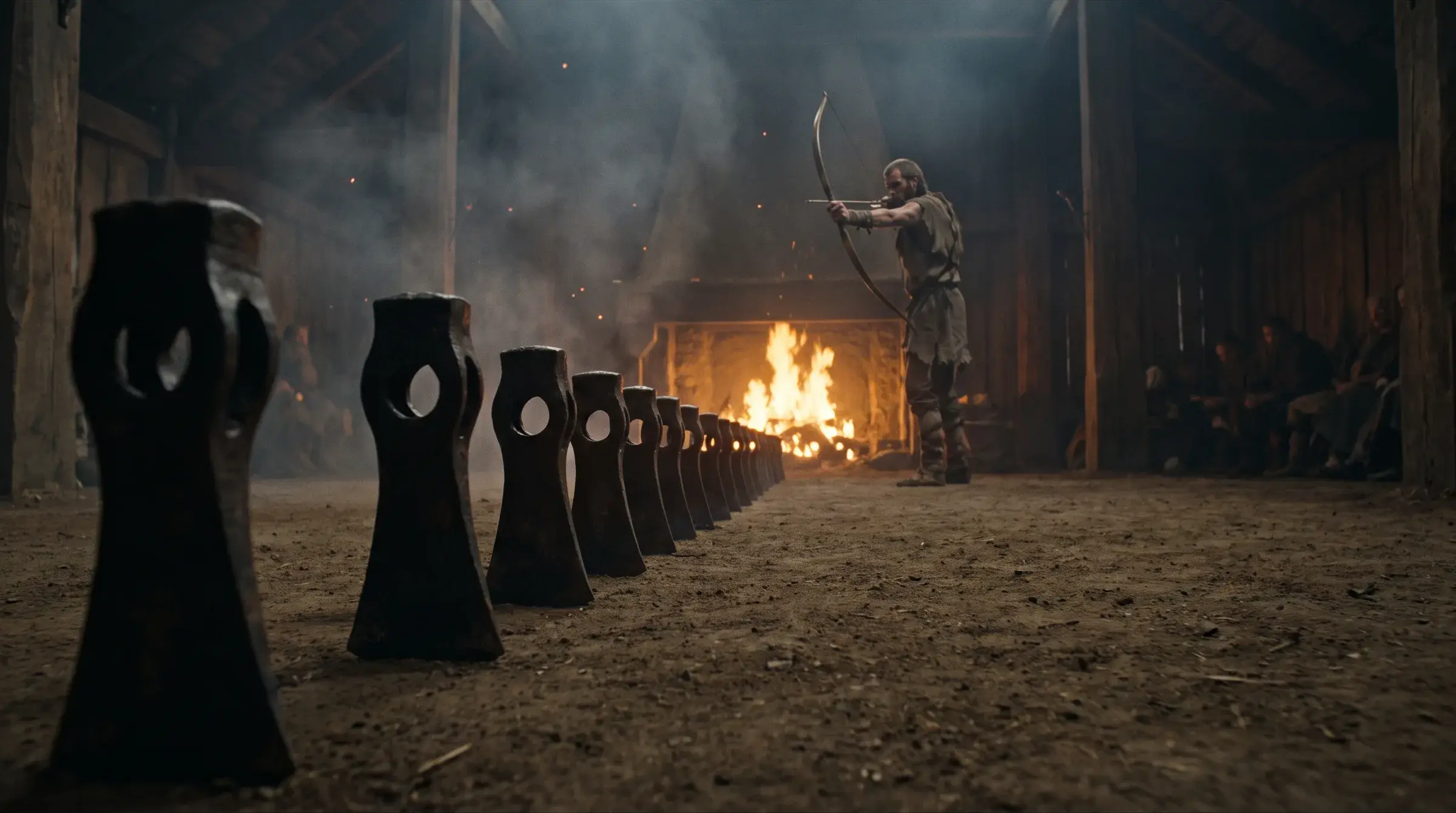
The third witness was the bow. Penelope brought out her husband’s weapon and announced a contest: she would marry whoever could string it and send an arrow through twelve axe heads set in a row. The suitors warmed the horn at the fire and rubbed it with fat; not one bent it halfway. Then the old beggar in the corner asked for the bow. He looked it over the way a musician looks over an instrument, and strung it without effort — and the first arrow went through all twelve rings. With the second he killed the nearest suitor.

Even after the killing, Penelope did not throw herself at him. She ordered their marriage bed carried out of the bedroom in front of him — and he exploded: that bed cannot be carried anywhere, he cut it himself from a living olive rooted in the ground and built the house around the trunk. Only then did she weep. Twenty years she had held out by cunning — and the last test she set was one she would not have passed herself.

ΤΕΛΟΣ

Twenty years, twelve ships and not one companion who came back. The only man who reached home was the one who refused, the whole way, to stay.

Other sagas